

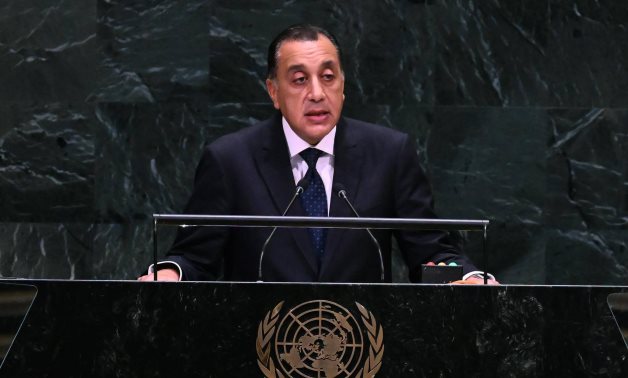

Prime Minister Mostafa Madbouly declared Nile water security an “uncompromisable existential reality” and outlined Egypt’s vision on priority files during his address to the 81st session of the UN General Assembly (UNGA) on Friday.
Madbouly, leading Egypt’s delegation to the UNGA on behalf of President Abdel Fattah El-Sisi delivered Egypt’s speech, covering regional security, Egyptian water security, reforms of the UN Security Council and global funding structures.
His address also included responsible use of AI and technology, means for a more effective international system, and the decline of the rule of international law.
Egypt Today sheds light on the prime minister’s key messages on Sudan, global reforms, water security, and the Palestinian cause.
Water and the Nile
During his remarks on Egypt’s Nile rights, Madbouly said:
Egypt’s water security is an existential matter that cannot be subject to compromise.
The Nile is not simply an economic resource, but a lifeline that has been linked to the existence and development of Egyptian society throughout history.
Egypt believes transboundary water resources should be an area for cooperation and integration rather than conflict.
Egypt believes water security and development are not competing objectives, but can be achieved together when there is political will, good faith and respect for international law.
Egypt does not oppose any people’s right to development, but defends a clear and fair principle: one party’s development must not come at the expense of others.
Shared resources cannot be managed through unilateral measures or a policy of imposing faits accomplis, but through cooperation, good-neighborly relations and binding agreements, in accordance with international law, that safeguard everyone’s legitimate rights and interests.
Egypt retains its legitimate right, guaranteed under the UN Charter and international law, to protect its water security and safeguard the vital interests of its people.
Gaza and Palestine
Regarding the Palestinian cause, Madbouly said:
The suffering, repression and violations endured by the Palestinian people must not become an accepted reality or a prolonged crisis managed from one round to another.
Consolidating the ceasefire in the Gaza Strip in accordance with President Trump’s peace plan and the Sharm El-Sheikh summit, ensuring full compliance with it, ending daily Israeli violations, completing the withdrawal, ensuring the safe and sustained delivery of humanitarian aid, and enabling the National Committee for the Administration of Gaza to begin its work, followed immediately by early recovery and reconstruction, are not merely humanitarian steps.
They are also the necessary entry point to a serious political process that addresses and ultimately ends the roots of the conflict.
The international community bears a clear responsibility to halt systematic Israeli violations of international law.
Peace cannot be built on the uprooting of a people from their land.
Any notion that regional stability can be achieved by ignoring Palestinian suffering and continuing to manage the occupation rather than end it is an illusion.
Palestinian Statehood Objective
The objective remains clear: establishing an independent, sovereign and geographically contiguous Palestinian state along the June 4, 1967 lines, with East Jerusalem as its capital, within the framework of the two-state solution and in accordance with international legitimacy resolutions.
This requires preserving the unity of the Palestinian territory and political system and empowering Palestinians to manage their affairs and build their state.
Also, the international community must fulfill its responsibility to protect civilians, reject collective punishment and uphold international humanitarian law.
Not Bargaining Chips
Palestinian rights must be treated as inalienable rights, rather than bargaining chips that can be granted or withdrawn according to shifts in the balance of power, political posturing or electoral calculations.
Egypt has fulfilled its responsibilities, in cooperation with its partners, to consolidate the ceasefire and has been the largest source of humanitarian aid reaching the Gaza Strip.
Egypt will continue working to support reconstruction and open a viable political horizon.
The success of these efforts remains dependent on international political will to translate international legitimacy into decisive action that moves beyond managing the tragedy toward ending its underlying causes.
Sudan Crisis
On the devastating and deadly war in Sudan, extending since April 2023, Madbouly said:
The crisis in neighboring Sudan extends beyond military confrontations to threaten the security and safety of civilians, while carrying the risk of dismantling state institutions.
In confronting these threats and risks, Sudan finds in Egypt a strong supporter of its people, its right to remain united, its institutions’ ability to safeguard its national resources, and justice that upholds the dignity of its people.
Regional Security
Outlining Egypt’s vision to achieve security across the Middle East, Madbouly said:
Egypt adheres to a clear vision for regional security based on the sovereignty and territorial integrity of states, respect for their national institutions, rejection of state fragmentation and parallel entities, and prioritization of political solutions and inclusive national settlements over the use of force and the imposition of faits accomplis.
Capable national states that unite all their citizens and legitimate institutions remain the two true and only foundations for stability.
Security is indivisible.
The security of one state cannot be built on the insecurity of its neighbors, threats to shipping, trade and energy routes, or violations of states’ sovereignty and attacks against them in breach of international law.
Any regional party that believes its political and economic interests can be achieved by undermining national state institutions, supporting militias, or backing separatist movements and civil conflict becomes, quite frankly, part of the problem.
Confronting such a party and its practices becomes the responsibility of the international community as a whole.
The region’s crises cannot be treated as isolated cases, but must instead be viewed within an interconnected regional and security environment.
Security Council, International Financing Reforms
Egypt remains committed to genuine and comprehensive reform of the UN Security Council in line with the Ezulwini Consensus and the relevant Sirte Declaration, particularly to address the historical injustice facing Africa.
The imbalance in political representation is mirrored in the global economy.
Developing countries are expected to accelerate development, create jobs, finance the green transition and adapt to crises while facing rising debt burdens, higher financing costs and shrinking fiscal space.
Reforming the international financial architecture has become a necessity rather than a luxury.
There is a need for more representative and responsive financial institutions, expanded concessional financing, greater capacity for multilateral development banks to mobilize resources and lend, and faster, fairer and more effective debt treatment.
We need to develop innovative financing tools and ensure a fairer system for assessing countries’ needs and investment risks.
Countries should not be forced to choose between servicing their debt and financing education, healthcare, food and infrastructure.
Development, he stressed, is not a grant but a right and a shared interest.