

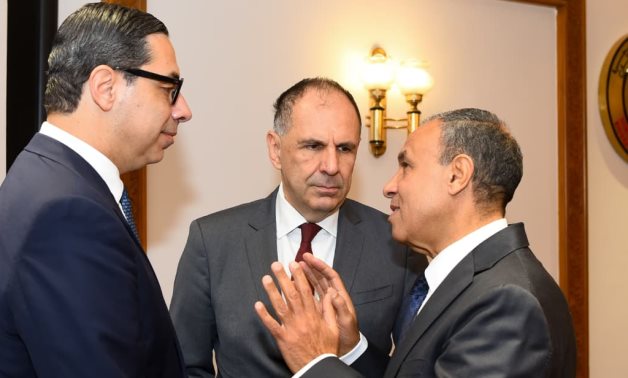
Egyptian Foreign Minister Badr Abdelatty discussed with his counterparts from Greece and Cyprus ways to facilitate legal and regulated migration, including sending seasonal Egyptian workers to both Greece and Cyprus in sectors where labor is needed in the two countries.
The Egyptian Foreign Minister held a tripartite meeting on Sunday with Mr. Giorgos Gerapetritis, Minister of Foreign Affairs of Greece, and Mr. Konstantinos Koumbos, Minister of Foreign Affairs of Cyprus.
The Abdelatty affirmed that trilateral cooperation in the field of migration constitutes a key pillar of this partnership, particularly in light of the challenges posed by irregular migration, Egypt’s hosting of more than 10 million foreigners of various nationalities in recent years, and the growing burden Egypt has borne in accommodating refugees and migrants. He stressed the importance of complementing efforts to combat irregular migration with parallel cooperation to facilitate legal and regulated migration.
He underscored the importance of holding regular meetings under the trilateral summit mechanism and ensuring continuous follow-up on the implementation of agreements and memoranda of understanding concluded during the trilateral summits, with a view to enhancing cooperation among the three countries.
The Egyptian Foreign Minister stressed the need to activate all aspects of trilateral relations and to maintain close coordination among the delegations of the three countries within the United Nations, as well as in international forums and relevant multilateral events, on various regional and international issues. He expressed appreciation for the supportive positions of Cyprus and Greece toward Egypt within the European Union and looked forward to continued coordination among the three countries, particularly during their respective presidencies of the European Union.
Minister Abdelatty also emphasized the importance of further developing trilateral cooperation in the economic, trade, investment, and tourism sectors, and of creating greater opportunities for private-sector engagement to enhance economic and trade ties. In this context, he noted that the trilateral partnership encompasses key strategic sectors, most notably energy, natural gas, and electricity interconnection. He expressed Egypt’s aspiration to expand and diversify trilateral cooperation to include emerging areas such as technology, innovation, entrepreneurship, and artificial intelligence.
During the trilateral meeting, the ministers exchanged views on regional and international issues of common interest, with discussions focusing in particular on developments in the Palestinian issue. They reviewed the next steps and procedures following the transition to the second phase of the U.S. President’s plan and the commencement of work by the Palestinian technocratic committee following the announcement of its formation.
The ministers also discussed developments in Libya, Syria, Lebanon, Yemen, Sudan, and Somalia, stressing the importance of preserving the unity, sovereignty, and territorial integrity of these countries, as well as ensuring the security of the Red Sea. They emphasized the need to enhance coordination and joint cooperation to address these challenges and to support efforts aimed at strengthening security and stability at both the regional and international levels.
At the conclusion of the meeting, the ministers agreed to continue consultations on issues of mutual interest in a manner that serves the interests of the three friendly countries, particularly in the Eastern Mediterranean. They underscored the importance of coordinating positions and deepening cooperation to advance shared interests and promote security and stability in the region.