

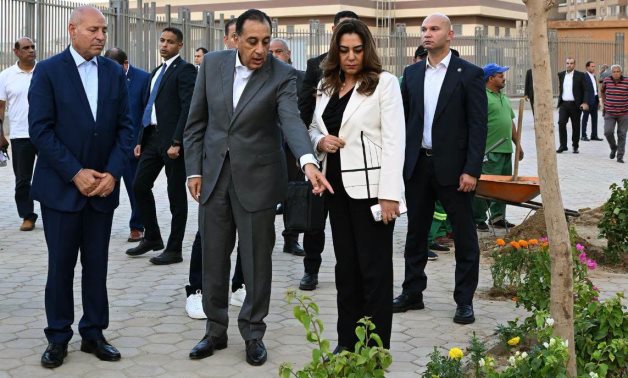

Following a meeting to review the implementation of President Abdel Fattah El-Sisi’s directives on the “Greening Greater Cairo” project, Prime Minister Dr. Mostafa Madbouly toured several tree-planting and agricultural projects in Cairo Governorate today.
He was accompanied by Dr. Manal Awad, Minister of Local Development and Environment, and Dr. Ibrahim Saber, Governor of Cairo.
Dr. Madbouly reaffirmed the government’s commitment to implementing a comprehensive plan to green governorates by transforming vacant and unused land, once cleared, into parks and green spaces. He stressed the importance of expanding tree cover and green areas along major roads, axes, medians, and city entrances to increase per-capita green space and improve quality of life.
Dr. Manal Awad affirmed the Ministry’s continued support for governorates in expanding tree-planting efforts, increasing green spaces, preserving existing trees, and upgrading open areas and road medians in line with the State’s vision for improving the urban environment.
During the tour, the Prime Minister inspected tree-planting works beneath the Ibrahim Al-Orabi Bridge (formerly the 10th Bridge), in the Athar Al-Nabi Bridge area, and beneath the Civilizations Axis (Mehwar Al-Hadarat). He stressed the need to continue and expand the project across all governorates.
Dr. Ibrahim Saber explained that Cairo’s greening plan was developed using a scientific approach, with a specialized consultancy firm selecting tree species suited to Egypt’s climate and water conditions. Priority was given to fast-growing, shade-providing species that require limited water and are compatible with sustainable irrigation systems. Selected species include Acacia, Nidusa, Khaya, Bauhinia, Delonix regia, Cassia fistula, and Jacaranda.
The Governor noted that implementation is already underway, with more than 3,000 trees and approximately 700,000 shrubs and plants planted along roads, thoroughfares, and vacant lots. Cairo aims to plant one million trees, shrubs, and plants within a year, including 60,000 trees and 800,000 shrubs and plants, while establishing a distinct botanical identity for each district based on its characteristics.
At the conclusion of the tour, Dr. Madbouly stressed that protecting and preserving trees is a shared responsibility between government authorities and citizens. He called for continued implementation of the project and its expansion across Greater Cairo.