

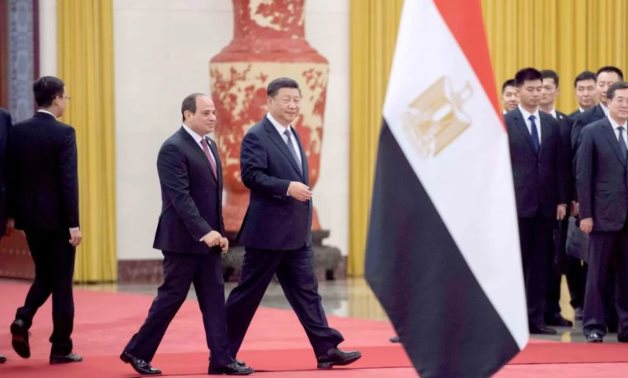

Egypt and China open new strategic chapter as Xi Jinping’s visit crowns 70 years of partnership
Seven decades after Egypt became the first Arab and African country to establish diplomatic relations with the People’s Republic of China, President Xi Jinping’s visit brings together history, strategic geography, industrial ambition and a shared vision for a changing international order.
What began as a pioneering diplomatic decision has evolved into a comprehensive strategic partnership spanning politics, infrastructure, industry, trade, technology, logistics and the future of the Global South.

Chinese President Xi Jinping’s visit to Egypt comes at a rare diplomatic moment in the history of relations between Cairo and Beijing.
It is not only a presidential visit.
It is the convergence of memory, geography, development, politics and global strategy.
It comes as Egypt and China mark 70 years since the establishment of diplomatic relations in 1956, when Egypt became the first Arab and African country to recognize the People’s Republic of China and open formal ties with Beijing.
It also comes at a time when both countries are seeking to turn their long-standing friendship into a deeper, more advanced partnership suited to a changing international order.
In a bylined article published to mark the occasion, President Abdel Fattah El-Sisi framed the relationship as one that extends beyond traditional diplomacy.
He presented it as a bond between two ancient civilizations, two central states in the Global South, and two partners seeking a more balanced, fair and development-oriented world.
Egypt and China are not simply celebrating the past. They are using the past as a foundation for the future.
A visit that goes beyond protocol
Xi’s visit to Egypt is expected to be his first state visit to the country in a decade, according to Reuters, with talks planned with President El-Sisi on bilateral relations and regional and international issues of common concern.
The visit comes as part of a wider trip from August 30 to September 3 that also includes participation in the Shanghai Cooperation Organization summit in Bishkek.
For Beijing, Egypt is not an ordinary stop on the diplomatic map.
It is a major Arab state, a leading African actor, a Mediterranean power, a Red Sea state, a gateway to the Middle East and Africa, and the country that controls the Suez Canal, one of the most important arteries of global trade.
For Cairo, China is not merely a major economy or an investment partner.
It is a permanent member of the UN Security Council, a central force in the Global South, a major player in infrastructure and technology, and a partner whose relationship with Egypt has moved from political recognition to comprehensive strategic cooperation.
This is why the visit carries weight.
It is a meeting between two states whose relationship has grown from history into strategy.
Why Egypt matters to China
Egypt combines strategic advantages rarely concentrated in a single state.
Egypt’s first-mover role in Arab and African engagement with China
The foundation of the relationship remains 1956.
Egypt’s decision to establish diplomatic relations with the People’s Republic of China made it the first Arab and African country to do so.
That was not a routine diplomatic step.
It reflected Egypt’s early ability to read the transformations of the post-colonial world and its willingness to build bridges with rising powers at a time when the international system was sharply divided.
This early recognition gave Egypt a unique place in China’s relations with the Arab world and Africa.
It opened a path that later expanded into wider China-Arab and China-Africa cooperation frameworks, including the China-Arab States Cooperation Forum and the Forum on China-Africa Cooperation.
Egypt opens the Arab and African diplomatic door
Cairo became the first Arab and African capital to establish diplomatic relations with the People’s Republic of China, giving Egypt a distinctive place in Beijing’s later engagement with both regions.
In political terms, Egypt was not simply one of China’s partners.
It was the door through which China built broader relations with two major regional spaces: the Arab world and Africa.
That remains one of Cairo’s strongest cards today.
Civilizational depth: from the Nile and Yangtze to a shared future
President El-Sisi’s article places strong emphasis on the civilizational depth of the relationship.
He links the Nile, as the cradle of Egyptian civilization and lifeline of Egyptians, with the Yangtze River, as a source of Chinese civilization, wisdom, culture and philosophy.
This is not decorative language.
It is a political message.
Egypt and China are both ancient states with long memories.
Their relationship is not built only on immediate interests, but on a shared sense that old civilizations can still shape modern development.
The reference to the Pyramids and the Great Wall is more than symbolism; it positions both countries as historical contributors to human progress, knowledge, science, architecture, medicine, engineering and astronomy.
A cradle of civilization, source of continuity and central element of Egypt’s national identity.
A source of Chinese civilization, cultural memory, philosophy and historical development.
That civilizational language gives the partnership a deeper identity.
It allows Cairo and Beijing to speak not only as governments, but as states with historical continuity, cultural confidence and a long view of global change.
From the Silk Road to the Suez Canal
One of the most powerful ideas in El-Sisi’s article is the connection between the ancient Silk Road and the modern Suez Canal.
The president notes that Egypt and China were linked by historic trade routes stretching from the Chinese Silk Road to the Red Sea and the Egyptian Suez Canal, which remains a lifeline of global trade.
He also highlights the historic role of Egyptian ports on the Red Sea and the Mediterranean as commercial hubs connecting Asia, Europe and Africa.
This point is central to understanding why Egypt matters to China today.
China’s global economic vision depends on routes, ports, industrial zones, logistics networks and secure access to markets.
Egypt sits at the intersection of all of these.
It is not only a transit point between East and West.
It is increasingly presenting itself as a manufacturing, logistics and export platform.
The Suez Canal gives Egypt geography. The Suez Canal Economic Zone gives it industrial strategy. Chinese investment gives that strategy a powerful international partner.
Comprehensive strategic partnership: the 2014 turning point
The modern transformation of Egypt-China relations accelerated in 2014, when the two countries elevated their ties to a comprehensive strategic partnership during President El-Sisi’s first official visit to China.
This upgrade came at a defining moment in Egypt’s foreign policy.
Cairo was working to diversify its international partnerships, deepen relations with major global powers, and build wider cooperation based on mutual respect, solidarity and mutual benefit.
The partnership has since expanded across infrastructure, investment, trade, manufacturing, technology transfer, renewable energy, transport, industrial zones and advanced sectors.
China has become one of Egypt’s major trade and economic partners, while Chinese direct investment has increased, including inside the Suez Canal Economic Zone.
The importance of this partnership is that it is not limited to one sector.
It covers the core elements of state modernization: infrastructure, industry, technology, logistics, energy and international positioning.
How the partnership evolved
Infrastructure as the foundation of Egypt’s regional rise
Few areas reflect the depth of cooperation more clearly than infrastructure.
Chinese companies have contributed to major Egyptian national projects, including the Central Business District in the New Capital, the electric railway to 10th of Ramadan City, renewable energy power plants and port development projects.
These projects form part of Egypt’s broader national plans to overhaul its infrastructure and build a more advanced economic base.
This is where Egypt’s role becomes larger than a bilateral relationship with China.
Over the past decade, Egypt has used infrastructure as a tool of national transformation.
Roads, ports, railways, energy stations, new cities and industrial zones are not isolated projects.
They are part of an attempt to reposition Egypt as a regional and global logistics hub for industry, trade and services.
El-Sisi’s article makes that connection clearly: modern infrastructure is described as a pillar for building an advanced and integrated industrial base and transforming Egypt into a global logistics hub.
In that sense, Chinese cooperation supports a wider Egyptian strategy.
Infrastructure turns geography into capability.
The New Capital and the visible face of partnership
The New Capital has become one of the most visible symbols of Egypt-China cooperation.
The Central Business District, built with major Chinese participation, is not just an architectural project.
It represents Egypt’s ambition to build a modern administrative and financial center that reflects a new phase of state development.
For China, participation in such a project places Chinese companies inside one of the most significant urban transformations in the Middle East.
For Egypt, the project shows how international partnerships can contribute to national modernization while reinforcing Cairo’s ability to host major business, financial and administrative activity.
The symbolism matters.
The skyline itself has become part of the political message: Egypt is building for the future, and China is one of the partners contributing to that transformation.
Suez Canal Economic Zone: the industrial heart of the next phase
The Suez Canal Economic Zone may become one of the most important arenas for the next stage of Egyptian-Chinese cooperation.
El-Sisi’s article highlights the zone as a major destination for Chinese direct investment and as a platform that offers Chinese investors opportunities to benefit from Egypt’s strategic location, infrastructure and competitive advantages.
The logic is clear.
Egypt does not want to remain only a market for imports or a passageway for ships.
It wants to become a production base, an industrial hub and an export platform connecting Asia, Africa, Europe and the Middle East.
Chinese companies can play a central role in that transformation by localizing production inside Egypt, creating jobs, transferring knowledge, connecting local supply chains and using Egypt as a regional manufacturing base.
Where Egyptian geography meets Chinese industrial capacity
That is why the Suez Canal Economic Zone is more than an investment area.
It is the place where Egypt’s geography, China’s industrial capacity and global trade routes meet.
Industrial localization: the real prize
One of the most important messages in El-Sisi’s article is the link between Egypt’s strategy for industrial localization and China’s strategy for high-quality development.
The president identifies several priority sectors for attracting greater Chinese industrial investment to Egypt, including electric vehicles, energy-storage batteries, renewable energy, electronics, components for seawater desalination plants, shipbuilding and other advanced industries.
This is the most forward-looking part of the relationship.
Egypt’s development challenge is not only to attract investment, but to attract the right kind of investment.
The next phase requires investment that creates local production, adds technology, develops skills and supports exports.
That is why the industrial localization agenda matters so much.
It moves cooperation from construction to production, from projects to factories, from importing goods to making them in Egypt.
Construction
Projects
Imports
Production
Factories
Made in Egypt
If this agenda advances, Egypt-China cooperation can become one of the engines of Egypt’s industrial rise.
Technology, AI and space: moving beyond traditional cooperation
The partnership is also expanding into advanced technology.
El-Sisi’s article specifically refers to cooperation in telecommunications, artificial intelligence and space sciences as key priorities for the next phase of economic and technological development.
This is strategically important because the future of development will not be shaped only by roads, bridges and ports.
It will be shaped by data centers, cloud computing, artificial intelligence, satellite systems, smart manufacturing, digital government, cybersecurity and communications infrastructure.
Egypt’s cooperation with China in these areas can help strengthen the country’s technological base and support its ambition to become a regional digital and industrial hub.
The message is clear: the next chapter of relations will not be limited to traditional infrastructure.
It will extend into the technologies that define future economic power.
Building the next economic layer
Egypt’s policy of strategic balance
Another major theme in El-Sisi’s article is Egypt’s policy of strategic balance.
The president emphasizes that Egypt has pursued an independent foreign policy at a time of intensifying polarization and competition, and that Cairo seeks broad and diverse partnerships with all countries of the world.
This is one of the most important political messages surrounding Xi’s visit.
Egypt’s relationship with China is not presented as a substitute for relations with other powers.
It is part of a wider Egyptian doctrine: openness to all, alignment with national interest, rejection of dependency, and commitment to balanced diplomacy.
This allows Egypt to work with China, the United States, Europe, Russia, the Arab world, Africa and multilateral institutions at the same time.
In an increasingly polarized world, the ability to maintain diverse partnerships without surrendering strategic independence is itself a form of power.
Egypt and China in the Global South
The visit also carries a strong Global South dimension.
El-Sisi’s article stresses Egypt’s support for strengthening the voice of the Global South and increasing its representation in international institutions.
It notes that Egypt joined BRICS in 2024, as well as the New Development Bank, the Asian Infrastructure Investment Bank and the Shanghai Cooperation Organization as a dialogue partner.
This places Egypt and China within a wider conversation about the future of the international order.
Both countries support a more balanced global system in which developing countries have greater voice, fairer access to development finance, and stronger representation in decision-making institutions.
For Egypt, this is not abstract diplomacy.
It is connected to development, financing, infrastructure, food security, climate resilience, technology and industrial growth.
For China, Egypt is a natural partner in advancing South-South cooperation because Cairo carries Arab, African and Mediterranean weight at the same time.
Egypt’s expanding multilateral footprint
Regional stability: Cairo’s indispensable diplomatic role
Xi’s visit also comes at a time of severe regional tension.
El-Sisi’s article highlights Egypt’s intensive diplomatic efforts to de-escalate the situation in the Middle East, prevent the expansion of conflict, and support peaceful political solutions.
It also notes that Egypt and China agree on resolving conflicts through peaceful means, respecting state sovereignty and taking into account the security concerns of all parties.
This is where Egypt’s regional role becomes central.
Cairo is deeply involved in the most sensitive files in the region: Gaza, Palestine, Sudan, Libya, the Red Sea, the Eastern Mediterranean and the Horn of Africa.
Its geography gives it exposure to crises, but its diplomacy gives it influence over them.
For China, stable regional routes, secure maritime trade, energy flows and political predictability are all vital.
Egypt is one of the few states capable of speaking across multiple regional files with institutional weight and diplomatic experience.
Egypt is not only a partner for Chinese investment. It is a partner in the stability of the region through which that investment, trade and energy must move.
The Nile message: cooperation, international law and no unilateral harm
One of the most politically significant sections of El-Sisi’s article concerns the Nile.
The president describes the river as the foundation of Egyptian civilization and a vital source of prosperity throughout history.
He also stresses Egypt’s continued support for development in Nile Basin countries, particularly in water resources development and dam construction, including in Sudan, Uganda and Tanzania’s Julius Nyerere Hydropower Project.
The message is carefully balanced but firm.
Egypt presents itself as a supporter of development in the Nile Basin, not an opponent of it.
At the same time, it emphasizes that transboundary cooperation must follow international law, reject unilateral approaches that harm downstream states, and rely on prior notification, consultation and consensus among riparian countries.
El-Sisi also highlights China’s recognition of the vital importance of the Nile to Egypt as its principal lifeline, and stresses the need to refrain from unilateral measures and strengthen good-faith cooperation for mutually beneficial outcomes.
Development and cooperation, without unilateral harm
This is a major diplomatic point.
It places Egypt’s water security within the same framework that shapes its wider foreign policy: cooperation, development, international law and rejection of harm.
Why Xi’s visit reinforces Egypt’s centrality
The deeper meaning of Xi’s visit lies in what it says about Egypt’s place in the world.
Major powers do not invest this level of attention in countries without strategic value.
Egypt’s value is layered: geography, history, population, regional diplomacy, access to Africa, access to the Arab world, the Suez Canal, the Red Sea, the Mediterranean, industrial zones, infrastructure, energy potential and political weight.
China’s engagement with Egypt reflects recognition of that reality.
For Beijing, Egypt is a central partner in the Middle East and Africa.
For Cairo, China is a partner that can support Egypt’s development and technological ambitions while reinforcing its position within a more multipolar world.
The relationship is therefore not based on sentiment alone.
It is based on strategic convergence.
Few countries connect this many strategic spaces at once
A partnership moving from history to future industries
The most important shift now is that Egypt-China relations are moving from historical friendship and infrastructure cooperation toward future industries.
The next phase is likely to focus on:
These are not marginal sectors.
They are the sectors that will define economic competition in the coming decades.
If Egypt succeeds in attracting more Chinese investment into these areas, the relationship will move from partnership to transformation.
A visit that crowns the past and opens the next chapter
President El-Sisi’s article ends with a forward-looking message: Egypt and China have written remarkable chapters of cooperation and friendship, and now look forward to writing a new chapter rooted in thousands of years of history and directed toward a more stable, secure, peaceful and developed world.
That is the essence of Xi Jinping’s visit.
It crowns 70 years of relations, but it is not only about commemoration.
It is about translating history into projects, geography into logistics, friendship into investment, and strategic trust into future industries.
For Egypt, the visit reinforces the country’s role as a central Arab, African and Global South power capable of engaging major international actors without losing its independent balance.
For China, the visit strengthens a partnership with a state that has the history, location, influence and development agenda needed to anchor Beijing’s engagement with the Middle East and Africa.
The story of Egypt-China relations is therefore no longer only the story of two old civilizations.
It is the story of two modern states trying to shape a more balanced world through development, infrastructure, technology, industry and diplomacy.
From the first Arab and African recognition of China to a partnership built around the industries of the future
Seven decades after diplomatic relations began, the partnership now stretches from the political legacy of 1956 to the Suez Canal Economic Zone, advanced manufacturing, renewable energy, artificial intelligence, logistics, space sciences and a wider vision for the Global South.
And at the center of that story stands Egypt: a country whose geography still links continents, whose diplomacy still carries regional weight, and whose development path increasingly attracts the attention of the world’s major powers.