

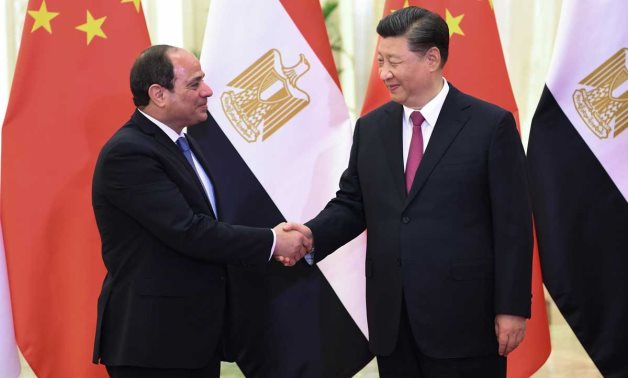

Xi Jinping’s Egypt message: Beijing sees Cairo as the bridge between history, development and a new Global South order
Ahead of his visit to Egypt, Chinese President Xi Jinping used a bylined article to frame Cairo not merely as a bilateral partner, but as a civilizational peer, a strategic development partner, an Arab-African gateway and a central actor in China’s vision for the Global South.
Beijing is presenting the visit not as a ceremonial stop, but as the beginning of a new strategic journey
The article links thousands of years of civilizational contact with modern infrastructure, industrial cooperation, the Belt and Road Initiative, cultural exchange, regional stability and Egypt’s growing role across the Arab world, Africa and the wider developing world.


Chinese President Xi Jinping’s visit to Egypt is not being framed by Beijing as a passing diplomatic occasion.
It is being presented as the opening of a new journey.
In a bylined article published on the 70th anniversary of Egypt-China diplomatic relations, Xi wrote that he would visit Egypt at the invitation of President Abdel Fattah El-Sisi, describing it as his second visit to “the fertile land nourished by the Nile” since assuming the presidency of China.
He recalled his previous visit to Egypt a decade ago, saying the country’s ancient civilization and its momentum toward progress left a deep impression on him.
That language gives the visit its real meaning.
This is not only about agreements, trade figures or protocol photos.
It is about how China sees Egypt: as a civilizational partner, a trusted political friend, an anchor of Arab-African cooperation, a gateway to the Global South, and a state whose geography and history still carry strategic weight in a changing world.
Xi’s article does something important.
It does not treat the Egypt-China relationship as a recent partnership built around infrastructure projects alone.
Instead, it places the relationship inside a much longer arc: ancient civilizations, anti-colonial solidarity, the Suez Canal, the United Nations, the Belt and Road Initiative, the New Capital, the Suez Canal Economic Zone, cultural exchange, multilateral diplomacy and the future of China-Arab and China-Africa cooperation.
In other words, Beijing is not simply celebrating 70 years of relations with Cairo.
It is saying that Egypt remains central to China’s view of the Middle East, Africa and the wider developing world.
Egypt is not being presented as one partner among many. It is being presented as a state capable of connecting China to multiple strategic regions at the same time.
A visit preceded by a political message
When a head of state writes an article before a visit, the purpose is rarely ceremonial only.
It is a way of setting the tone before the summit begins.
It tells the host country, the public, the business community and the wider region what the visitor wants the trip to mean.
Xi’s message was clear: China wants to deepen its comprehensive strategic partnership with Egypt and draw “new outlines” for friendship and cooperation with President El-Sisi.
That formulation matters because it suggests that the visit is not limited to celebrating the past.
It is designed to shape the next phase.
For Egypt, this carries significant diplomatic value.
Cairo is being addressed by Beijing not only as a bilateral partner, but as a country with wider regional influence.
For China, Egypt represents a stable and historic entry point into the Arab world, Africa, the Mediterranean and the Red Sea.
This is why the visit is politically heavy.
It brings together two states that speak the language of sovereignty, development, stability, civilizational identity and a more balanced international order.
It also comes at a moment when the world is increasingly divided by economic rivalry, regional conflicts, maritime security concerns and competition over global influence.
Against that background, Xi’s article presents Egypt-China relations as a model of continuity in a turbulent age.
How Xi’s article frames Egypt
Five layers of strategic value run through the Chinese president’s message.
The Nile, the Yangtze and the Yellow River
One of the most striking parts of Xi’s article is its civilizational framing.
He links China’s ancient civilization, born around the Yangtze and Yellow rivers, with Egypt’s ancient civilization, born around the Nile.
He writes that the two civilizations admired each other despite geographical distance, with goods, knowledge and technologies moving through ancient land and maritime Silk Road routes over thousands of years.
This is not just poetic diplomacy.
It is a statement about status.
China is telling Egypt: our relationship is not ordinary because our histories are not ordinary.
Both countries are old civilizations that became modern states.
Both carry a deep historical memory.
Both see culture not as decoration, but as part of national identity and international influence.
Xi also pointed to Chinese artifacts found at the Fustat archaeological site as evidence of old links between the two peoples.
That reference is particularly smart.
Fustat is not a vague symbol.
It is Egyptian soil carrying material evidence of ancient contact with China.
It turns the idea of historical friendship from diplomatic rhetoric into an archaeological and civilizational fact.
Civilization, continuity and the historical foundation of the Egyptian state.
Civilizational memory, historic exchange and the roots of modern China.
The message is powerful: the Egypt-China relationship did not begin with today’s leaders, and it does not end with today’s projects.
Seventy years of relations, but centuries of contact
Xi’s article marks 70 years since the establishment of diplomatic relations between Egypt and China.
He describes that step as opening the gate of friendship and cooperation between China and the Arab and African worlds.
He adds that the relationship stood firm through international changes and became a model for cooperation between China and Arab and African countries, as well as for solidarity among developing states.
This framing puts Egypt at the beginning of a wider diplomatic road.
From Beijing’s view, Egypt was not merely one of many countries that developed relations with China.
It was a leading Arab and African state that helped open a wider space for China’s engagement with two major regions.
That is exactly where Egypt’s strategic value lies.
Egypt is not important only because of its population, market or location.
It is important because it operates across several circles at once.
It is Arab, African, Mediterranean, Red Sea, Islamic, Global South and central to the question of Palestine.
It also controls the Suez Canal, one of the world’s most vital routes for trade.
Few countries offer that combination.
That is why Xi’s visit should be read as recognition of Egypt’s accumulated diplomatic weight.
But Xi’s argument reaches far beyond the anniversary itself, placing the relationship inside centuries of trade, political solidarity and civilizational interaction.
From Suez solidarity to UN support
The article also highlights the political memory that shaped the relationship.
Xi recalls China’s strong solidarity with Egypt in its struggle to restore sovereignty over the Suez Canal.
In return, he notes Egypt’s firm position, alongside many Asian, African and Latin American countries, in supporting China’s restoration of its lawful seat at the United Nations.
This is a central point because it shows that the relationship was not born from trade alone.
It was built through moments of political support on issues connected to sovereignty and international recognition.
For Egypt, the Suez Canal has always been more than a waterway.
It is a symbol of sovereignty, independence and national dignity.
For China, the UN seat was a matter of international legitimacy and rightful representation.
By recalling these moments, Xi is reminding both countries that their partnership has a political foundation deeper than current economic interests.
This gives the relationship resilience.
Projects may change.
Markets may fluctuate.
But states that share historical memories of support often build more durable ties.
A relationship built on more than economics
Comprehensive strategic partnership under El-Sisi and Xi
The modern era of Egypt-China relations has been shaped strongly by President El-Sisi and President Xi.
In Xi’s article, the relationship is repeatedly described as a comprehensive strategic partnership.
That phrase is not casual.
It means the partnership extends beyond normal diplomatic friendship into wide cooperation across political, economic, cultural, technological and international files.
The article presents Egypt and China as two trusted partners seeking mutual benefit through cooperation.
It describes Egypt as an important trade and investment partner for China in the Arab world and Africa, and one of the early participants in Belt and Road cooperation.
This reflects one of the strongest features of Egypt’s diplomacy under President El-Sisi: widening partnerships while preserving strategic balance.
Egypt works with China without cutting itself off from the United States, Europe, the Gulf, Russia, Africa or international institutions.
This ability to engage multiple powers at the same time is one of Cairo’s most important foreign policy assets.
Xi’s visit reinforces that approach.
It shows that Egypt can attract the attention of major global powers while maintaining an independent national path rooted in its own development priorities.
Suez Canal Economic Zone: the bridge between geography and industry
The Suez Canal Economic Zone occupies a special place in Xi’s message.
He recalls that he and President El-Sisi jointly inaugurated the China-Egypt Suez Economic and Trade Cooperation Zone ten years ago, saying it brought major investments and broad job opportunities to Egypt and helped accelerate Egypt’s modernization process.
This is one of the most important parts of the article because it identifies the future of the relationship.
The Suez Canal has always given Egypt unmatched geographic value.
But the Suez Canal Economic Zone is about turning that value into industrial capability.
It is the difference between being a passage for global trade and becoming a platform for production, logistics, exports and value-added manufacturing.
For China, the zone fits naturally with Belt and Road priorities: ports, corridors, industrial clusters and trade connectivity.
For Egypt, the zone supports a national ambition to become a manufacturing and logistics hub linking Asia, Africa, Europe and the Middle East.
That is why Chinese investment there is strategically important.
It helps Egypt move from geography as location to geography as economic power.
The Suez Canal gives Egypt location. The Economic Zone turns location into production, exports, logistics and industrial power.
The New Capital, the tower and the train
Xi’s article also refers to Chinese companies completing major projects in Egypt, including the tallest building and the first electric railway in Africa.
This reference speaks directly to the visible side of cooperation.
The tallest building points to the Central Business District in the New Capital, one of the most recognizable symbols of Egypt’s modern urban transformation.
The electric railway reflects the transport modernization that links cities, industry and new communities.
These are not isolated engineering achievements.
They are part of a larger state-building process.
Egypt is constructing new infrastructure to absorb growth, organize administration, connect development zones, expand logistics, attract investment and support long-term economic transformation.
Chinese participation in these projects gives the partnership a physical presence.
It is not hidden inside diplomatic communiqués.
It is visible in buildings, railways, industrial zones, energy projects and business districts.
That is why the Egypt-China relationship has become easy to explain to ordinary citizens.
People can see it.
The visible face of the partnership
Egyptian oranges and the meaning of market access
One of the most interesting details in Xi’s article is the reference to fresh Egyptian oranges entering the Chinese market among the first batch of African products after China implemented tariff exemption measures for imports from African countries with diplomatic relations with Beijing.
This detail may seem small next to towers, railways and industrial zones, but it is highly significant.
It shows that Egypt-China cooperation is not only about mega projects.
It can also touch agriculture, exports, farmers, food supply chains and market access.
For Egypt, expanding exports to China is a strategic priority.
The trade relationship is strong, but the next stage should be about increasing Egyptian value-added exports, not only increasing imports from China.
Agricultural products, food industries, textiles, pharmaceuticals, fertilizers, chemicals, building materials and manufactured goods can all become stronger pillars of Egyptian access to the Chinese market if the right logistics, standards and trade promotion mechanisms are developed.
In that sense, the orange becomes a symbol: Egyptian products can reach Chinese consumers if the partnership is used smartly.
A shipment of Egyptian oranges can say something important about the future of the relationship
The next phase can expand from infrastructure and investment into exports, agriculture, food industries and greater Egyptian access to the Chinese consumer market.
Culture as strategic capital
The article gives major attention to cultural and people-to-people relations.
Xi notes that Egypt was the first Arab and African country to sign a cultural cooperation agreement with China.
He also points to rising Chinese tourism to Egyptian landmarks, the popularity of the “Ancient Egyptian Civilization” exhibition in Shanghai, the teaching of Chinese in more than 40 secondary schools in Egypt, and cooperation in vocational education.
This section is crucial because cultural relations often decide whether a strategic partnership remains elite-level or becomes people-level.
Government agreements can build frameworks.
Companies can build projects.
But societies build continuity.
When Chinese tourists visit Egyptian monuments, when Egyptian students learn Chinese, when cultural exhibitions attract public attention in Shanghai, and when vocational education creates skills, the relationship becomes less abstract.
It moves into classrooms, museums, training centers, tourism routes and personal memories.
For Egypt, this is a major opportunity.
China is one of the world’s largest sources of outbound tourism.
It is also a major center of technology, manufacturing and vocational training.
A deeper cultural and educational relationship can create long-term economic and social value.
The future of Egypt-China relations will depend not only on presidents and investors, but on students, tourists, engineers, workers, translators, archaeologists and entrepreneurs.
From state-to-state ties to people-to-people ties
Palestine, regional stability and the Global South
Xi’s article places Egypt and China together on major international and regional issues.
He writes that both sides support the just cause of the Palestinian people in restoring their legitimate national rights, seek political solutions to hot issues, and work for peace and stability in the region.
He frames this as part of their responsibility as members of the Global South committed to solidarity, fairness and justice.
This is particularly important because it connects the bilateral relationship to Egypt’s regional role.
Egypt has long been central to the Palestinian file, Gaza mediation, humanitarian access and efforts to prevent wider escalation.
China, meanwhile, has increasingly presented itself as a supporter of political solutions and a voice for developing countries in international affairs.
The convergence here is not only rhetorical.
Egypt’s regional experience and China’s global diplomatic weight can complement each other on issues where stability, reconstruction and development are central.
For Cairo, Chinese recognition of Egypt’s role in the region strengthens its diplomatic position.
For Beijing, cooperation with Egypt gives it a serious partner with direct regional knowledge and access.
Regional access and experience
Direct involvement in Palestine, Gaza, Red Sea security and wider Middle East diplomacy.
Global diplomatic weight
UN Security Council influence, economic reach and growing engagement with developing countries.
Egypt and China as development states
Another powerful theme in Xi’s article is development.
He writes that both China and Egypt are going through a decisive stage of development and renaissance.
China is moving forward with its national economic and social development plans and its modernization model, while Egypt is witnessing prosperous development in building the “New Republic” and moving confidently toward the goals of Egypt Vision 2030.
This is one of the strongest conceptual links between the two countries.
Both states put development at the center of national legitimacy.
Both view infrastructure, industry, technology and modernization as tools of national strength.
Both prefer long-term planning and state-led strategic projects.
That shared development language makes cooperation easier.
China brings industrial systems, financing capabilities, technology, equipment and construction experience.
Egypt brings population scale, location, resources, a large market, regional access and ambitious development needs.
Xi explicitly identifies these complementary advantages and calls for deeper alignment between the two countries’ development strategies.
This is where the partnership can become transformative.
If Egypt uses Chinese cooperation to localize industry, transfer technology, train labor, expand exports and strengthen manufacturing, the relationship can become one of the drivers of Egypt’s economic rise.
Complementary strengths
Industry, technology, financing capacity, equipment and construction experience.
Geography, population, market size, regional access, infrastructure and development ambition.
The next phase: not just friendship, but modernization
Xi’s proposed agenda for the future rests on several pillars.
First, strengthening mutual trust and passing friendship from one generation to another.
Second, achieving mutual benefit and common development by aligning development strategies and expanding high-quality Belt and Road cooperation.
Third, deepening civilizational exchange in education, tourism, science, technology, health, sports and archaeology.
Fourth, advancing together in defense of fairness, justice, peace, stability and genuine multilateralism.
Fifth, using Egypt’s role as a major Arab and African country to lead and deepen China-Arab and China-Africa cooperation.
This is not a narrow agenda.
It is a full strategic program.
It places Egypt at the intersection of five circles: bilateral development, cultural exchange, multilateral diplomacy, Arab cooperation, and African cooperation.
That is why the visit matters so much.
It is not only about what Egypt and China will sign.
It is about where both countries want the relationship to stand in the next decade.
Egypt as China’s Arab-African gateway
Perhaps the clearest strategic sentence in Xi’s article concerns Egypt’s role as a link to the Arab world and a gateway to Africa.
He writes that Egypt, as a major Arab and African state, plays an important role in advancing collective cooperation between China and Arab countries and between China and African countries.
He adds that China wants to work with Egypt to expand the model impact of mature Egypt-China cooperation and use Egypt’s unique geographic advantage as a bridge to the Arab world and a gateway to Africa.
This is one of the strongest acknowledgments of Egypt’s regional centrality.
China is effectively saying that cooperation with Egypt does not stop at Egypt’s borders.
It can influence wider cooperation with the Arab world and Africa.
For Egypt, this is exactly the strategic position it seeks to consolidate: not just a recipient of investment, but a regional platform; not only a historic state, but a connector of markets and regions; not only a partner, but a hub.
That is what makes Egypt indispensable.
It is difficult to build a serious China-Arab or China-Africa strategy without Cairo being part of the equation.
A bridge to the Arab world and a gateway to Africa
The significance of this formulation is that Beijing sees cooperation with Egypt as capable of generating effects beyond Egypt itself.
A sophisticated message before a strategic visit
Xi’s article is carefully constructed.
It begins with personal warmth and cultural memory.
It moves into history and political solidarity.
It highlights practical cooperation and visible achievements.
It praises people-to-people exchange.
It links both countries to Global South diplomacy.
It then lays out a future agenda based on trust, development, civilization, justice and Arab-African cooperation.
That structure tells us how Beijing wants the visit to be understood.
Not as a one-day event.
Not as a routine anniversary.
Not as a commercial mission only.
But as a strategic reaffirmation that Egypt and China are moving together from historical friendship toward a deeper partnership in modernization, regional coordination and global governance.
How Xi built the message
Why the visit strengthens Egypt’s diplomatic position
For Egypt, the political value of Xi’s visit is substantial.
It confirms that Cairo remains a priority destination for one of the world’s major powers.
It reinforces Egypt’s position as a central state in the Arab world and Africa.
It supports Egypt’s policy of diversified partnerships.
It highlights the New Republic and Egypt Vision 2030 as frameworks that attract international engagement.
It gives further momentum to industrial zones, infrastructure projects, technological cooperation and cultural exchange.
Most importantly, it shows that Egypt is not being approached by China as a passive market.
It is being approached as a strategic partner with regional weight.
That distinction matters.
A market buys and sells.
A partner shapes routes, projects, platforms and political coordination.
Xi’s article clearly places Egypt in the second category.
Buys and sells
Commercial exchange alone does not define strategic status.
Shapes routes and regions
Projects, logistics, industrial platforms, political coordination and access to wider markets.
Conclusion: a relationship entering its most strategic phase
The 70th anniversary of Egypt-China relations arrives at a moment when both countries are thinking beyond ceremony.
China sees Egypt as a friend, partner, civilizational peer, development ally and regional gateway.
Egypt sees China as a major global power capable of supporting infrastructure, industrial localization, technology, investment, cultural exchange and Global South coordination.
The visit of President Xi Jinping gives this relationship a new political push.
It confirms that the partnership has moved beyond the language of old friendship into the language of future-building: modernization, Belt and Road cooperation, industrial zones, technology, cultural exchange, multilateralism, Palestine, Arab-African cooperation and shared development.
The deeper story is not only that Egypt and China have known each other for 70 years.
The deeper story is that after 70 years, both countries are still finding new reasons to need each other.
Egypt brings geography, history, regional influence and a national development project.
China brings industrial capacity, technology, investment and global weight.
Together, they are presenting their relationship as a model of how old civilizations can build modern partnerships in a world searching for balance.
That is why Xi’s visit matters.
It is a visit to Egypt, but its message reaches far beyond Cairo.
Egypt remains one of the key doors through which China engages the Arab world, Africa and the Global South
Xi’s message presents Cairo’s role as a bridge between regions not as a slogan, but as a strategic reality rooted in geography, history, development, infrastructure, culture and political influence.
And the next chapter of Egypt-China relations will be judged not only by memories of the past, but by what both countries build from here.