

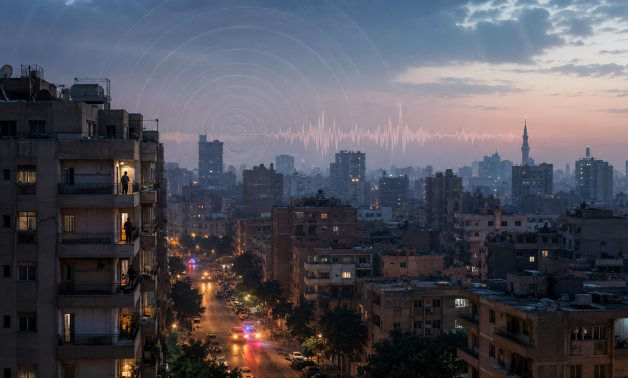

Egypt on alert after early-morning earthquake felt across Cairo and several governorates
Emergency rooms were linked nationwide, hospitals and ambulances were placed on alert, and officials reported no casualties or property damage in the first hours after a magnitude 5.5 to 5.6 tremor was felt across parts of Egypt.



Egypt woke up before dawn on Monday to a rare moment of collective alarm, after an earthquake was felt by residents in Cairo and several governorates at around 3 a.m., sending many people to social media and prompting state agencies to activate emergency procedures.
The tremor was recorded at a magnitude of around 5.5, according to data attributed to the National Research Institute of Astronomy and Geophysics, while some emergency updates referred to a 5.6-magnitude event in the first hours after the quake.
The institute said the epicenter was located about 38 kilometers from Suez, at a depth of around 10 kilometers, and that several technical statements were issued in quick succession as measurements arrived from different monitoring stations and were updated.
Although the shaking caused fear among many residents, especially because it occurred while most people were asleep, the immediate official message was one of reassurance.
The Ministry of Health said the health situation remained stable and that no quake-related injuries had been recorded as of its statement.
The Egyptian Red Crescent also said it had not received reports of injuries or property damage, while emergency rooms continued monitoring the situation.
Emergency readiness was activated nationwide, while authorities reported no earthquake-related injuries or confirmed property damage.

What officials reported
Preliminary information issued during the first hours after the earthquake
A few seconds that raised national concern
For many residents of Greater Cairo, the earthquake was felt as a sudden movement of beds, windows, furniture, ceiling lights or doors.
In some areas, the tremor was strong enough to wake people from sleep. In others, it was felt only lightly or not at all.
That difference is normal in earthquakes.
The magnitude of an earthquake describes the energy released at the source, but the intensity felt by people on the ground depends on several factors: distance from the epicenter, depth, local soil conditions, building structure, floor level, and whether a person is indoors, outdoors, awake, asleep, standing or lying down.
The US Geological Survey notes that earthquake damage depends on variables such as distance from the earthquake, soil type and building construction, and that damage does not usually begin until magnitudes rise somewhere above 4 or 5, depending on these conditions.
That explains why the same earthquake may feel frightening in one neighborhood, barely noticeable in another, and completely unfelt elsewhere.
In Monday’s case, the relatively shallow depth of around 10 kilometers helped make the tremor noticeable to a wider number of people, while the absence of early official reports of casualties or major damage helped reduce fears of a wider disaster.

What the official data showed
The first important detail is timing. The earthquake was recorded at about 3 a.m. local time on Monday, August 3, 2026.
Early readings placed the magnitude at around 5.5 to 5.6, with the National Research Institute of Astronomy and Geophysics cited as reporting a 5.5-magnitude tremor felt in Cairo and several governorates.
The second important detail is location.
According to reports citing the institute, the epicenter was about 38 kilometers from Suez.
This places the event in a sensitive zone between the eastern side of Greater Cairo, the Suez region, and areas influenced by seismic activity linked to the Gulf of Suez system.
The third detail is depth.
A depth of around 10 kilometers is considered shallow in general seismological terms.
Shallow earthquakes are often felt more clearly than deeper ones of similar magnitude because their seismic waves have less distance to travel before reaching the surface.
The fourth detail is that the readings were adjusted.
The head of the institute said three statements were issued in less than two hours because readings were arriving successively from different monitoring points and were being updated according to the latest measurements.
This is not unusual.
In the minutes after an earthquake, early estimates can change as additional seismic stations transmit data and analysts refine the location, depth and magnitude.
Why the magnitude changed in early reports
Initial earthquake readings are preliminary. As more monitoring stations transmit data, specialists refine the magnitude, depth, and exact location. A shift from 5.6 to 5.5 does not indicate a second earthquake; it reflects improved measurement.
Why people were afraid
The fear caused by Monday’s earthquake was not only about its strength. It was also about timing.
A tremor at 3 a.m. catches people at their most vulnerable moment.
Many are asleep. Streets are quiet. Families may not know whether to leave the building, stay indoors, call emergency services, or wait for official statements.
In that environment, uncertainty can become more alarming than the tremor itself.
This is why the official response mattered.
The first hours after an earthquake are about information as much as rescue.
Citizens need to know whether there are injuries, whether buildings have been damaged, whether hospitals are ready, whether aftershocks are expected, and which phone numbers to call if something happens.
Monday’s response showed the importance of providing quick, official information to reassure citizens and prevent rumors from spreading.

Crisis rooms linked across the country
Central and governorate-level operations rooms monitored the situation, collected reports, and coordinated with health, ambulance, civil protection, and utility authorities.
Health Ministry activates emergency plan
The Ministry of Health and Population moved quickly after the tremor was felt, announcing the activation of the health emergency plan on the directives of Deputy Prime Minister and Minister of Health and Population Khaled Abdel Ghaffar.
The ministry said the central crisis and emergency room at its headquarters in the New Capital was convened and linked with emergency rooms in health directorates across the governorates to ensure real-time monitoring of the health situation around the clock.
The ministry also raised the level of readiness in emergency and critical care departments across hospitals nationwide.
It confirmed the readiness of the Egyptian Ambulance Authority, ambulance vehicles and rapid deployment teams, while reviewing the availability of medicines, medical supplies, blood bags and oxygen.
Most importantly for the public, the ministry said all health facilities were operating normally and that it had not received reports of injuries or health losses caused by the earthquake at the time of its statement.
This type of response is standard in a country with dense urban areas.
Even when no casualties are reported, emergency rooms and ambulance units must be placed on alert because injuries can be reported later, particularly from panic, falls, stairway accidents, broken glass, gas leaks or damaged older buildings.

Ambulances, hospitals and critical care on alert
The Health Ministry’s decision to raise hospital readiness was not only a precautionary bureaucratic step.
In earthquakes, the first layer of public risk is structural damage. The second layer is medical overload.
If a building collapses, if panic leads residents to rush down staircases, or if a gas leak causes a fire, hospitals need to absorb sudden pressure within minutes.
That is why the ministry focused on emergency departments, intensive and critical care units, ambulance readiness, blood supplies, oxygen and rapid deployment teams.
Even in a quake that produces no major casualties, these systems are placed on alert because the final picture is not always clear in the first hour.
The ministry also urged citizens to communicate through emergency numbers in case of urgent medical need: ambulance services on 123, health emergencies on 137, and the Health Ministry hotline on 105.

Ambulances and emergency teams on standby
Health authorities reviewed ambulance deployment, emergency departments, critical care capacity, blood supplies, oxygen, medicines, and rapid-response resources.
Egyptian Red Crescent monitors affected cities
The Egyptian Red Crescent also activated its emergency plan in cities where residents felt the tremor, according to local reporting.
It said its operations room was following the impact of the quake and that no reports of human casualties or property damage had been received as of its statement.
The Red Crescent issued practical instructions to citizens, including avoiding old buildings or structures showing visible cracks, calling the emergency hotline 15322 only for urgent cases, and following official updates through its official channels.
This guidance is particularly important in Cairo and older urban centers, where some buildings may already suffer from structural weakness, unauthorized modifications, poor maintenance, added floors, or age-related cracks.
A moderate tremor may not damage a safe building, but it can expose existing vulnerabilities in an unsafe one.

Cairo Governorate reports no immediate losses
Cairo Governorate said no reports or complaints had been received indicating losses or damage within the governorate as a result of the tremor, according to the statements provided in the official updates.
It also raised readiness across executive bodies and used the National Emergency and Public Safety Network control center to contact districts and relevant authorities, in coordination with utilities police and civil protection units.
The governorate said it would continue monitoring the situation around the clock and called on citizens to report emergencies through the central operations room hotlines 15496 and 114.
Cairo Governorate’s official contact page also lists 114 and 15496 as its hotline numbers.
The significance of Cairo’s response is clear: the capital contains some of the country’s densest residential areas, older neighborhoods, major hospitals, government buildings, transport arteries and informal or aging housing stock.
Even when a quake causes no direct damage, Cairo must verify quickly that no local building, bridge, tunnel, service line or emergency facility has been affected.
Could there be aftershocks?
Aftershocks are a normal part of many earthquake sequences.
They are usually smaller than the mainshock, but they can still be felt, and in some cases they may be strong enough to cause concern or additional damage to already weakened structures.
USGS explains that aftershock rates generally decrease with time, but a significant aftershock can temporarily increase activity again.
It also notes that the magnitudes of aftershocks do not necessarily become smaller with time; rather, the rate of aftershocks usually declines.
For Egypt, the key point is that citizens should remain calm but alert.
A possible aftershock does not mean a larger disaster is coming.
It means people should avoid damaged buildings, check gas and electricity safely, keep emergency numbers available, and follow official statements instead of rumors.
The National Research Institute of Astronomy and Geophysics and the Egyptian National Seismic Network monitor seismic activity continuously, which allows authorities to detect and analyze any follow-up tremors.
Aftershocks are possible after many earthquakes, but their possibility does not mean a larger quake is certain or predictable.
Is Egypt an earthquake-prone country?
Egypt is not located on one of the world’s main destructive earthquake belts in the way that countries such as Turkey, Japan, Indonesia or Chile are.
However, Egypt is not completely isolated from seismic activity.
Experts from the National Research Institute of Astronomy and Geophysics have repeatedly explained that Egypt lies away from the major global earthquake belts, but can still feel tremors because of its proximity to active zones such as the Gulf of Aqaba, the Gulf of Suez, the Red Sea and parts of the Eastern Mediterranean.
The most relevant zones for Egypt include the Gulf of Aqaba, the Gulf of Suez, the Red Sea, and the Eastern Mediterranean region near Cyprus and Crete.
Earthquakes in those areas may be felt in Egyptian cities depending on their magnitude, depth and distance.
This means Egypt’s seismic risk is real, but it is different from the risk faced by countries sitting directly on major plate boundaries.
The danger in Egypt is less about frequent catastrophic earthquakes and more about preparedness, building quality, public awareness, emergency coordination and rapid official communication.
Seismic zones relevant to Egypt
Why the Suez region matters
The Suez and Sinai region has long been important in Egypt’s seismic map.
A scientific study on the December 31, 2018 Cairo-Suez earthquake noted that a shallow earthquake took place 25 kilometers east of Cairo near the New Capital area, and that the event was consistent with the tectonic regime of the region, linked to an on-land continuation of the Gulf of Suez extensional process.
That context helps explain why tremors east of Cairo or near Suez can be felt across the capital.
The area is not the world’s most dangerous seismic zone, but it has geological structures capable of producing noticeable earthquakes.
For the public, the key lesson is not panic.
It is that eastern Greater Cairo, Suez, parts of Sinai and the Gulf regions should remain part of national seismic planning, building-code awareness and emergency training.
The role of Egypt’s National Seismic Network
Egypt’s ability to respond to tremors depends heavily on the Egyptian National Seismic Network, operated by the National Research Institute of Astronomy and Geophysics.
The network was developed after major seismic events, including the 1981 Kalabsha earthquake in Aswan and the destructive October 12, 1992 earthquake, which caused heavy human and material losses.
According to NRIAG, the 1992 earthquake led the Egyptian government to order the installation and operation of the Egyptian National Seismological Network and the Strong-Motion Network.
The national network is designed to digitally acquire and process seismological data in real time and exchange earthquake information rapidly.
The International Federation of Digital Seismograph Networks describes Egypt’s network as a fully automated system dedicated to digital acquisition, real-time processing and rapid exchange of earthquake information.
Local reports have also described the network as one of the region’s advanced monitoring systems, noting that Egypt has a long history of earthquake records and a national network with a main center and regional centers receiving data from dozens of stations.
This infrastructure is the reason officials can identify the timing, strength, depth and location of tremors quickly, even when the public is still trying to understand what happened.
1981The Kalabsha earthquake highlighted the importance of national seismic monitoring.
1992The destructive Cairo earthquake accelerated the establishment of modern seismic and strong-motion networks.
TodayMonitoring stations transmit digital data for real-time analysis of location, depth, timing, and magnitude.
During Monday’s earthquakeSuccessive station readings allowed officials to refine the preliminary measurements and issue updated statements.
Why early readings can change
One source of confusion after earthquakes is the difference between initial alerts, preliminary estimates and final technical readings.
When an earthquake happens, seismic waves reach different monitoring stations at different times.
Early systems may produce an initial estimate based on limited data.
As more stations report, the magnitude, epicenter and depth may be revised.
This appears to have happened on Monday, with NRIAG’s head explaining that multiple statements were issued in less than two hours because measurements arrived successively from different monitoring points and were adjusted according to later readings.
For newsrooms, this is important.
Early figures should be described carefully as preliminary unless clearly confirmed.
If one official body says 5.6 and another later technical reading says 5.5, the responsible formulation is: “around 5.5,” “reported at 5.5 to 5.6 in early statements,” or “the institute later cited 5.5.”
What citizens should do during an earthquake
The clearest global safety advice is simple: drop, cover and hold on.
The CDC says that in most cases, people should drop to their hands and knees, cover their head and neck under a sturdy table or desk if possible, and hold on until the shaking stops.
If no shelter is nearby, people should get down near an interior wall or low furniture that will not fall, and cover the head and neck with arms and hands.
People indoors should generally stay indoors during shaking rather than rushing outside, because running through stairwells, glass, falling objects or crowded exits can increase injury risk.
The CDC also advises people to move away from glass, hanging objects, bookcases, large furniture and windows if possible within the few seconds before shaking intensifies.
People in high-rise buildings should move away from windows and outside walls, drop, cover and hold on, and avoid elevators.
Elevators can stop suddenly if power is cut, leaving people trapped.
If a person is outside, they should move to an open area away from trees, telephone poles and buildings.
If someone is driving, they should stop safely away from bridges, power lines, tunnels or overpasses.
Drop, cover and hold on
What citizens should do after the shaking stops
After an earthquake, the first instinct is often to run downstairs or gather under buildings.
That can be dangerous, especially if objects are still falling or if stairwells are crowded.
The safer approach is to check yourself and those around you for injuries, then assess your surroundings carefully.
If you smell gas, hear a leak, see sparks, or notice damaged wiring, avoid flames and switches and contact emergency services.
The CDC recommends knowing how to shut off utilities, including gas, electricity and water, and teaching family members how and when to do so.
Citizens should avoid old or visibly cracked buildings, as the Egyptian Red Crescent advised after Monday’s tremor.
They should also avoid standing under balconies, damaged walls, glass facades, electricity poles or signage.
For coastal areas, global earthquake guidance advises moving away from the shore if severe shaking lasts 20 seconds or more, because strong offshore earthquakes can generate tsunami risks in some settings.
The CDC advises immediate movement to high ground if severe shaking near the shore lasts 20 seconds or more.
This does not mean every earthquake in Egypt creates a tsunami risk.
It means coastal safety should be part of public awareness, especially along the Mediterranean and Red Sea coasts.
After the earthquake stops
What not to do
Do not use elevators during or immediately after shaking.
Do not rush to staircases while the building is moving.
Do not stand next to windows, mirrors, glass doors, cupboards, heavy shelves or hanging objects.
Do not stand in a doorway assuming it is the safest place.
Modern guidance says people are generally safer under a sturdy table, because doorways do not protect from the most common earthquake injuries: falling or flying objects.
Do not spread unofficial warnings about “a bigger earthquake coming.”
Earthquakes cannot be predicted with precise time, place and magnitude using current science.
Egyptian officials have previously stressed that the national network monitors and analyzes tremors after they occur; it does not predict them in advance.
Do not call emergency hotlines unless there is a real emergency.
Keeping lines clear helps responders reach people who need urgent help.
Do not
Emergency numbers citizens should keep
For medical emergencies, the Ministry of Health directed citizens to contact ambulance services on 123, health emergencies on 137, and the ministry hotline on 105.
For Egyptian Red Crescent emergency cases, citizens can call 15322, according to its post-quake instructions.
For Cairo Governorate’s central operations room, the official hotline numbers are 15496 and 114.
These numbers should be used only when there is a real emergency, visible damage, injury, trapped persons, gas leaks, fire risks, or an unsafe building condition.
Emergency hotlines
The bigger lesson: preparedness matters more than panic
Monday’s earthquake may pass without major damage, but it should not pass without lessons.
The first lesson is that Egypt’s emergency system can move quickly when there is a sudden natural event.
The Health Ministry activated a central crisis room, connected it to governorate emergency rooms, raised hospital readiness, checked ambulances and reviewed medical supplies.
The second lesson is that communication matters.
In the absence of quick official statements, rumors fill the space.
Earthquakes happen suddenly, but panic spreads even faster.
The third lesson is that old buildings need attention.
Even if a moderate tremor causes no direct damage, citizens should report visible cracks, leaning walls, falling plaster, damaged columns or unsafe balconies.
These signs matter more in older neighborhoods and buildings with unauthorized construction.
The fourth lesson is that earthquake awareness should become part of public culture.
Schools, workplaces, hospitals and residential compounds need simple drills: where to stand, where not to stand, how to shut gas, how to avoid elevators, how to evacuate after shaking stops, and who to call.
Preparedness does not mean living in fear. It means knowing what to do in the first 30 seconds.
Why this earthquake became a national story
Egyptians experience many minor tremors without major concern.
But Monday’s quake became a national story for several reasons.
It happened before dawn.
It was felt in the capital.
It reached a magnitude strong enough to be noticed by a wide public.
It came after repeated recent discussions about seismic activity in and around Egypt.
It triggered public concern about older buildings, emergency preparedness and whether aftershocks could follow.
It also came at a time when mobile alerts, social media posts and instant news updates can make a natural event feel larger and more immediate than in the past.
But the available official picture remained stable in the first hours: a noticeable earthquake, emergency readiness activated, no reported injuries by the Health Ministry, no damage reports received by the Red Crescent, and continued monitoring by the relevant agencies.
Readiness matters more than fear
The early-morning tremor lasted only seconds, but Egypt’s response showed the value of preparedness, coordination, and clear public guidance.
With hospitals, ambulances, emergency rooms, the Red Crescent, and local authorities placed on alert, the official picture remained reassuring: no quake-related injuries had been reported, and monitoring continued around the clock.
Natural events cannot always be prevented, but fast response, accurate information, safer buildings, and public awareness can reduce fear and protect lives.