

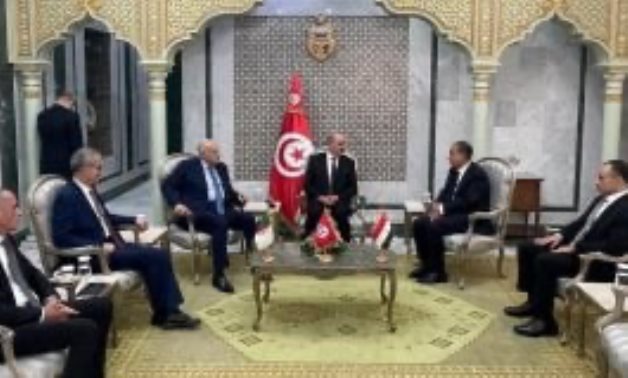
Egyptian Foreign Minister Badr Abdelatty joined his Tunisian and Algerian counterparts in Tunis on Monday for consultation aimed at breaking the political deadlock in Libya.
The three ministers reaffirmed their long-standing unified stance against foreign interference in the war-torn nation.
The meeting, which brought together Abdelatty, Tunisian Foreign Minister Mohamed Ali Nafti, and Algerian Foreign Minister Ahmed Attaf, marks the latest activation of the tripartite mechanism—a diplomatic framework designed to coordinate the security and political positions of the three countries sharing extensive borders with Libya.
According to a statement from the Egyptian Ministry of Foreign Affairs, the ministers engaged in extensive discussions regarding the current Libyan landscape. The talks focused on the necessity of a “Libyan-owned and Libyan-led” political process, free from external dictates which have historically exacerbated internal divisions.
Push for Elections
Top of the agenda was the acceleration of the electoral track. The three diplomats underscored the urgency of creating the necessary climate to hold simultaneous presidential and parliamentary elections. They called on Libyan factions to bridge their differences and agree on electoral laws that would facilitate a peaceful transition of power, ending the transitional periods that have plagued the country for over a decade.
Significant to the talks was the presence of Hanna Tetteh, the Special Envoy of the UN Secretary-General for Libya, signaling a strong alignment between the tripartite neighbors and international efforts to stabilize the region.
Rejecting Foreign Interference
In a strong rebuke of external involvement, the ministers reiterated their categorical rejection of foreign military presence in Libya. They emphasized that the security of Libya is inextricably linked to the national security of Egypt, Tunisia, and Algeria.
The statement said the presence of mercenaries and foreign fighters poses a direct threat not only to Libyan sovereignty but to the stability of the entire North African and Sahel region.
The ministers agreed to intensify coordination in the coming months to prevent any escalation on the ground and to support the unification of Libyan state institutions, particularly the military and security apparatuses.
The meeting concluded with a pledge to continue these consultations, aiming to speak with one voice in international forums regarding the Libyan file.