

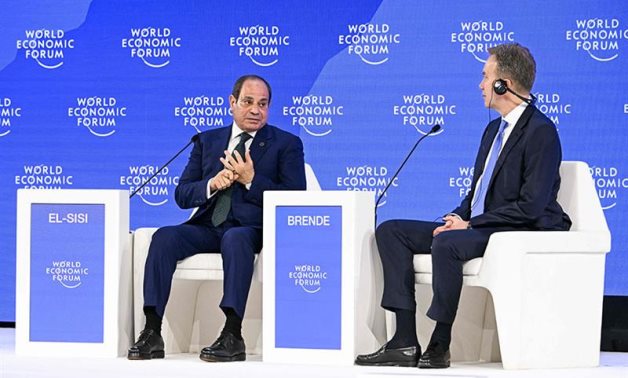
“Egypt’s policy is based on supporting and maintaining stability, not just domestically but also regionally and internationally,” President Abdel Fattah El-Sisi told participants during a dedicated Egypt session at the World Economic Forum (WEF) in Davos, highlighting the country’s economic reforms, investment opportunities, and active role in promoting regional stability.
Upon arrival at the conference hall, El-Sisi was welcomed by WEF Chairman Børge Brende, with whom he held a bilateral meeting before addressing the main session. Brende underscored Egypt’s distinguished position in the global economy.
During the session, El-Sisi outlined Egypt’s decade-long efforts to maintain both national and regional stability. He emphasized that stability forms a cornerstone of the country’s economic infrastructure and is key to attracting private investment.
“Egypt has been a stabilizing force during years of unrest in the region since 2011,” he added. The president detailed Egypt’s infrastructure achievements, citing a modern network of ports, roads, airports, and energy facilities, alongside strategic projects such as the Suez Canal Economic Zone.
He stressed the canal’s global significance, noting that it handles roughly 12% of world trade.Despite regional crises over the past two years, Egypt continued canal operations, absorbing direct revenue losses of approximately $9 billion while ensuring conflict de-escalation and facilitating humanitarian aid deliveries, including to Gaza.
On economic reform, El-Sisi highlighted legislative and fiscal measures designed to strengthen the business environment and attract private investment.
He pointed to the empowerment of the private sector through public investment caps, state divestments, and the implementation of the State Ownership Policy and government IPO program.
He also highlighted Egypt’s free trade agreements with African and Arab markets, providing investors access to large regional markets.
The president stressed investment opportunities in priority sectors, including artificial intelligence, electric vehicles, pharmaceuticals, logistics, and education.
He noted that Egypt has over 30 million young people enrolled across various stages of education, forming a talent base prepared to engage in advanced technologies and digital innovation. These efforts, he said, are part of a broader plan to prepare Egypt for the future economy and to achieve sustainable development goals by 2030.
El-Sisi also reaffirmed Egypt’s commitment to non-interference while supporting the restoration of legitimate state institutions in neighboring countries, including Libya, Sudan, Lebanon, Syria, Yemen, and Somalia.
He highlighted the country’s active role in de-escalating conflicts, delivering humanitarian aid, and restoring stability, reinforcing Egypt’s image as a responsible regional partner.
On infrastructure and logistics, the president noted the country has built a modern network linking Mediterranean and Red Sea ports through advanced road and rail systems, complemented by upgraded airports and energy networks.
He described Egypt’s approach as holistic, integrating economic reform, infrastructure development, and stability to create an environment conducive to long-term investment and growth.
Concluding the session, El-Sisi invited investors and business leaders to seize Egypt’s strategic opportunities, emphasizing that these initiatives form part of a broader national strategy to ensure economic resilience, sustainable development, and regional leadership.